From feeding alone
to nutrient control that reads drainage
Knowing how much you supplied but not how much the roots actually took up is where root zone disorders begin. Our patented direct-mixing fertigation unit and standards-compliant drainage sensors measure feed and drainage together, and FarmPath AI turns the readings back into a prescription.
Feed data alone cannot tell you
what is happening in the root zone
For salt-sensitive crops such as strawberry and tomato, even a small drift in the root zone environment pulls down both yield and quality. The trouble is that it almost always starts before you can see it.
Salt accumulation is spotted too late
Without drainage EC, you cannot see nutrients building up in the root zone. By the time it shows as root stress and slowed growth, it is already too late.
Irrigation volume is set by feel
Without drainage volume there is no basis for judging over- or under-watering. Growing media differ in water-holding capacity, yet every one gets irrigated the same way.
Raw water quality keeps shifting
When iron and calcium in groundwater vary by season, the same prescription gives a different result and drip lines clog.
Reliable data starts with
precision hardware
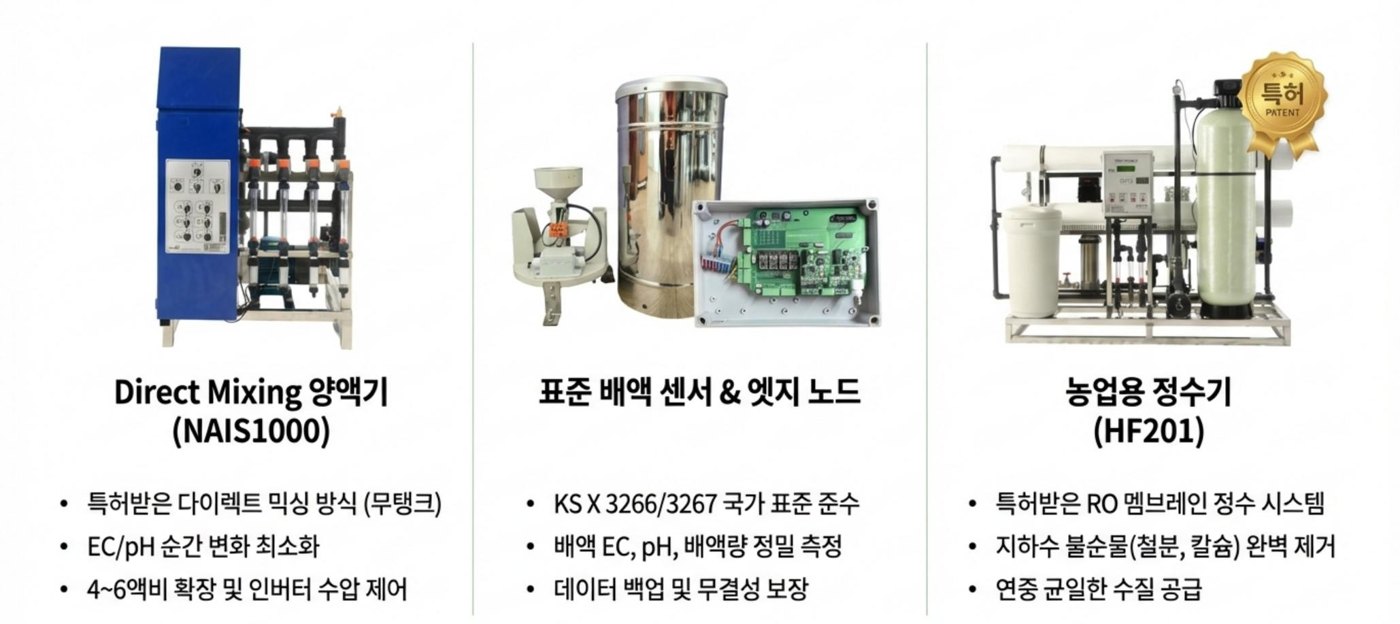
Direct-mixing fertigation unit
- Patented direct-mixing design — blends in the pipeline with no mixing tank
- Minimal instantaneous EC/pH swing — reduces the concentration spike at the start of feeding
- Expandable to 4–6 stock solutions — element-by-element dosing for reproducible prescriptions
- Inverter-based pressure control — holds drip pressure steady
Standards-compliant drainage sensor · edge node
- Compliant with KS X 3266 / 3267 — measurement based on national standards
- Precise drainage EC, pH and volume — drainage ratio derived from the gap against the feed
- Guaranteed data integrity — if the link drops, readings are stored locally on the fertigation unit and synced on recovery
- Root zone moisture sensor integration — substrate moisture content factored into the judgement
Agricultural water purifier
- Patented RO membrane treatment — purifies raw water by reverse osmosis
- Removes iron, calcium and other impurities — reduces drip clogging and scale
- Uniform water quality year-round — absorbs seasonal swings in raw water
- Direct coupling to the fertigation unit — one line from treatment through to feeding
What to control, and how closely
These are the four indicators read from the drainage. For each one we also show what happens when it drifts out of range and what to adjust.
| Factor | Target range | Out of range | Management action |
|---|---|---|---|
| Drainage EC | feed +0.3 – 0.8 dS/m |
▲ Too high Salt accumulation impedes water uptake by the roots and growth slows. Strawberry is especially sensitive to salt stress. ▼ Too low Over-irrigation with feeding solution leaches and wastes nutrients, and induces excessive vegetative growth. |
Monitor drainage EC and keep feed EC within the target range. Salt accumulation onset and leaching risk are flagged in advance. |
| Drainage pH | 5.5 – 6.5 |
▲ Too high Uptake of micronutrients such as iron and manganese falls, and deficiency symptoms appear on new leaves. ▼ Too low Calcium and magnesium uptake is impeded, and leaf tip burn and root damage accelerate. |
Respond with foliar application or by adjusting irrigation frequency and volume before deficiency symptoms show on the leaves. |
| Drainage volume | 20 – 30% of feed |
▲ Too much The root zone becomes waterlogged and nutrient leaching increases, softening fruit and lowering sugar content. ▼ Too little Salts build up in the root zone, causing wilting, poor fruit enlargement and malformed fruit. |
Adjust irrigation frequency and volume. Water-holding and drainage capacity differ by growing medium, so manage the drainage volume that suits your substrate. |
| Drainage temperature | 18 – 25℃ |
▲ Too high Root respiration and senescence accelerate, and root zone oxygen runs short. ▼ Too low Root vigour and nutrient uptake decline, delaying new leaf expansion. |
When too low, insulate the raw water tank and heat the feeding solution; when too high, shade the feed tank and switch to small, frequent feeds. |
These target values are compiled for protected strawberry cultivation and need adjusting for your crop, growing medium and cropping season.
From measurement to prescription,
in a single flow
It does not end with a sensor taking a reading. The drainage ratio is calculated from the gap between feed and drainage, and FarmPath's RAG-based AI builds a management recommendation matched to the growth stage, delivered to the app and dashboard.
- Immediate anomaly detection — you get an alert as soon as a reading leaves the target range
- No loss during network outages — stored locally on the fertigation unit and synced on recovery
- Prescriptions by growth stage — EC/pH deviation and drainage ratio read together to propose the adjustment
- Usable by elderly and less-experienced growers — guidance on what to do next, not a list of numbers
On-site measurement
The fertigation unit and drainage meter collect EC, pH, flow rate and temperature of both feed and drainage in real time.
Edge node analysis
The drainage ratio is calculated from the feed-to-drainage gap and anomalies are flagged. If the link drops, data is stored locally.
Cloud · AI processing
FarmPath's RAG-based AI combines in-house sensor data with verified cultivation references to derive a control strategy.
Recommendations · alerts
Optimal feed volume, EC, pH and root zone temperature for each growth stage are delivered to the app and dashboard, with advance warnings when risk is expected.
Live installations
The nutrient supply unit and root zone measurement unit at a protected strawberry farm. Click to enlarge.
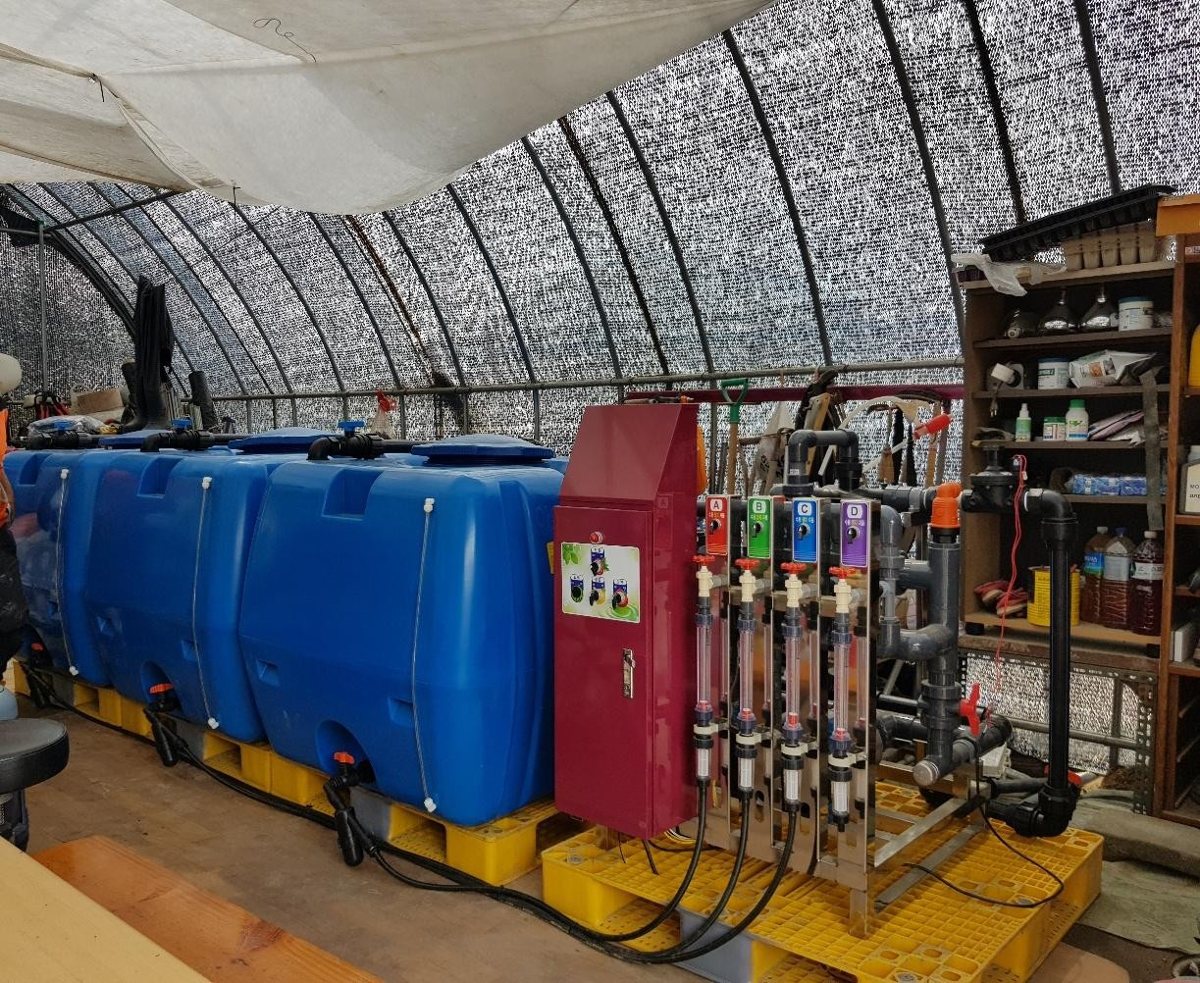
Nutrient supply unit
Element-by-element dosing · flow-meter based volumetric control
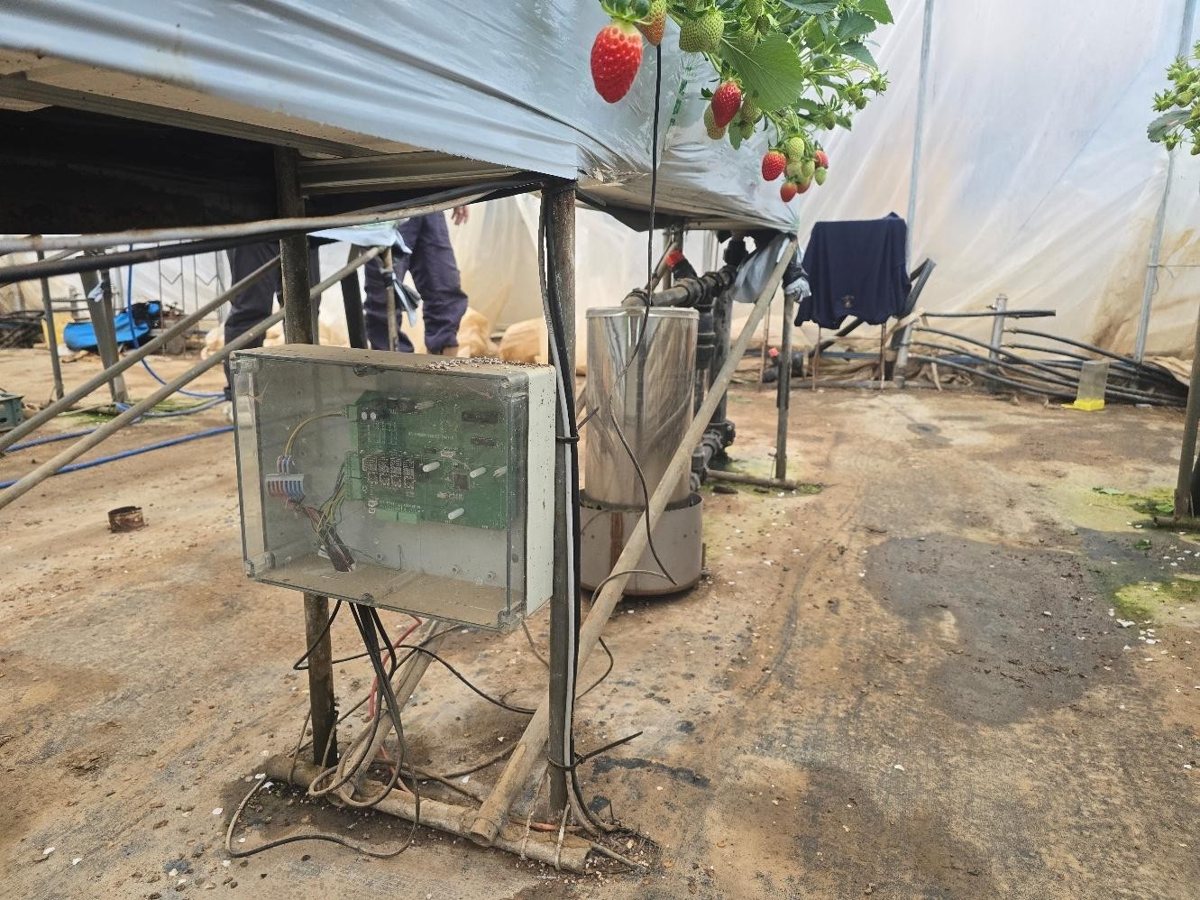
Root zone measurement unit
Drainage EC, pH and volume measurement · edge node integration
What the field trial aims to prove
The figures below are targets set for the demonstration project, not results already achieved. They will be verified against the same months of the previous year, and we will publish the outcome as measured.
After installation, results are compared directly against the same month of the previous year. Productivity is measured on April output; economics on drainage volume and nutrient cost in April, September, October and November. The comparison baseline is fixed in advance so the numbers can actually be interpreted.
Reading feed and drainage together lets you stop salt accumulation and root stress before symptoms appear. Because the AI flags over- and under-feeding with objective evidence, senior growers and those with less experience can still manage scientifically. The accumulated records become a manual to share with growers in the region.
Manufacturing by a specialist,
analytics by FarmPath
The fertigation units and agricultural water purifiers are manufactured by IoTFarm Co., Ltd. FarmPath is responsible for the drainage data analytics system and the AI prescriptions. Each partner takes on what it does best, connecting hardware through to prescription as one system.
- Manufacturing
- IoTFarm Co., Ltd.
- Location
- Nonsan, Chungcheongnam-do, Korea
- Founded
- 2015
- Main products
- Fertigation units, agricultural water purifiers
- Analytics & AI
- FarmPath Inc.
- Field-proven — installation and after-sales capability built on manufacturing and selling more than 1,000 fertigation units
- Overseas supply — exports to China and Uzbekistan; nutrient irrigation equipment for a strawberry plant factory in Tokyo, Japan
- Award — National IoT Grand Prize (Public Choice)
Registered patents
Additional patents cover waste nutrient solution recycling equipment, plant cultivators for plant factories, and manure treatment systems.
Certification · standards
Where we deploy
Strawberry elevated bed cultivation
Root zone management for a salt-sensitive crop. Feed prescriptions are adjusted from drainage EC and drainage volume.
Tomato and fruit vegetable greenhouses
Used for stepping EC up by growth stage and for moisture management during fruit enlargement.
Plant factories · container farms
Fully controlled environments that need uniform feeding per tier and rack plus waste nutrient solution management.
Farms on groundwater
Sites where raw water quality shifts with the seasons. Water treatment secures reproducible prescriptions.
The configuration varies with farm size, crop, and the growing medium and raw water conditions you work with. Tell us about your current setup and we will put together a deployment plan.